Global Smartphone Market Slumps in Q1: Why Experts Predict a Harder Year Ahead

The Global Smartphone Market is Bracing for a Tough 2026
If you’ve been tracking the tech world lately, you might have noticed things feeling a bit tight. According to the latest data from TrendForce, global smartphone production hit 284 million units in the first quarter of 2026. While that might sound like a massive number, it actually represents a 1.7% dip compared to the same period last year. It’s a small crack in the foundation, but the industry is preparing for some much bigger tremors ahead.
The Memory Crisis Looming on the Horizon
Right now, phone manufacturers are essentially living off their leftovers. They’ve been utilizing stockpiles of memory purchased when prices were lower, which has kept the impact on consumers minimal so far. However, those reserves are drying up fast. As these cheap stockpiles vanish, brands are facing a difficult choice: absorb the higher costs or pass them on to you.
The outlook for the rest of the year is fairly sobering. Analysts are projecting a 16.2% drop in total annual production, potentially landing at around 1.051 billion units. TrendForce warns that if memory prices continue their upward climb, we could see brands repeatedly hiking retail prices just to keep their heads above water.
Who Wins and Who Loses?
Not every manufacturer is in the same boat. Companies that dominate the premium tier—where profit margins are thick—are much better positioned to weather this storm. On the flip side, brands that built their reputation on budget-friendly and mid-range devices are likely to feel the most pain as their narrow margins disappear.
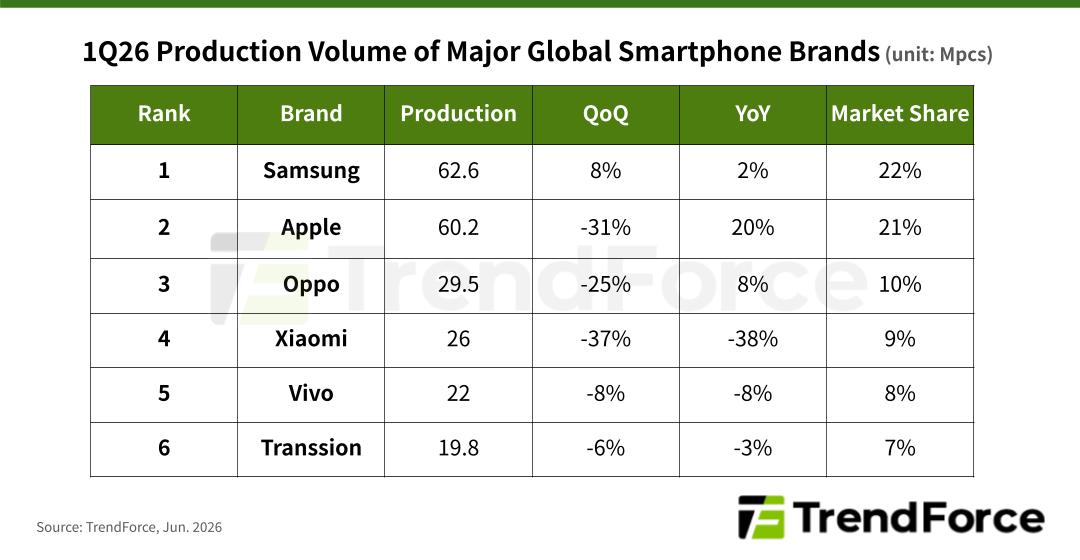
Samsung and Apple: The Heavyweights Holding Steady
Samsung maintained its lead in Q1, producing 62.6 million units—a 2.3% increase over last year. Much of this momentum came from the launch of the Galaxy S26 series. While Samsung’s cheaper models are a bit of a concern due to rising part costs, the company’s massive financial reach gives it a safety net that smaller rivals simply don’t have.
Meanwhile, Apple secured the #2 spot with an impressive 60.2 million units produced. That’s a staggering 19.7% jump from Q1 2025, largely fueled by the runaway success of the iPhone 17e. Because Apple operates with such high margins, they are actually using this period of market instability to aggressively expand their market share while others are forced to scale back.
The Battle for the Mid-Range
Rounding out the top five are Oppo (29.5 million), Xiaomi (26 million), and vivo (22 million), with Transsion trailing just behind at 19.8 million. These companies have seen incredible growth over the last few years, but they are now entering a “pressure cooker” environment. With component shortages cutting into profitability, the aggressive pricing strategies that made them famous are being put to the ultimate test.
About The Author





